>
IT News
>
When One Employee Becomes the Attack Surface: What the May 2026 Carnival Data Breach Reveals About Modern Cyber Risk
When One Employee Becomes the Attack Surface: What the May 2026 Carnival Data Breach Reveals About Modern Cyber Risk
In late May 2026, Carnival Corporation disclosed a significant cybersecurity breach impacting nearly six million individuals. According to public disclosures, attackers gained access through a compromised employee account after successfully using social engineering techniques. The breach resulted in unauthorized access to personal information including names, addresses, contact information, and certain government identification details.

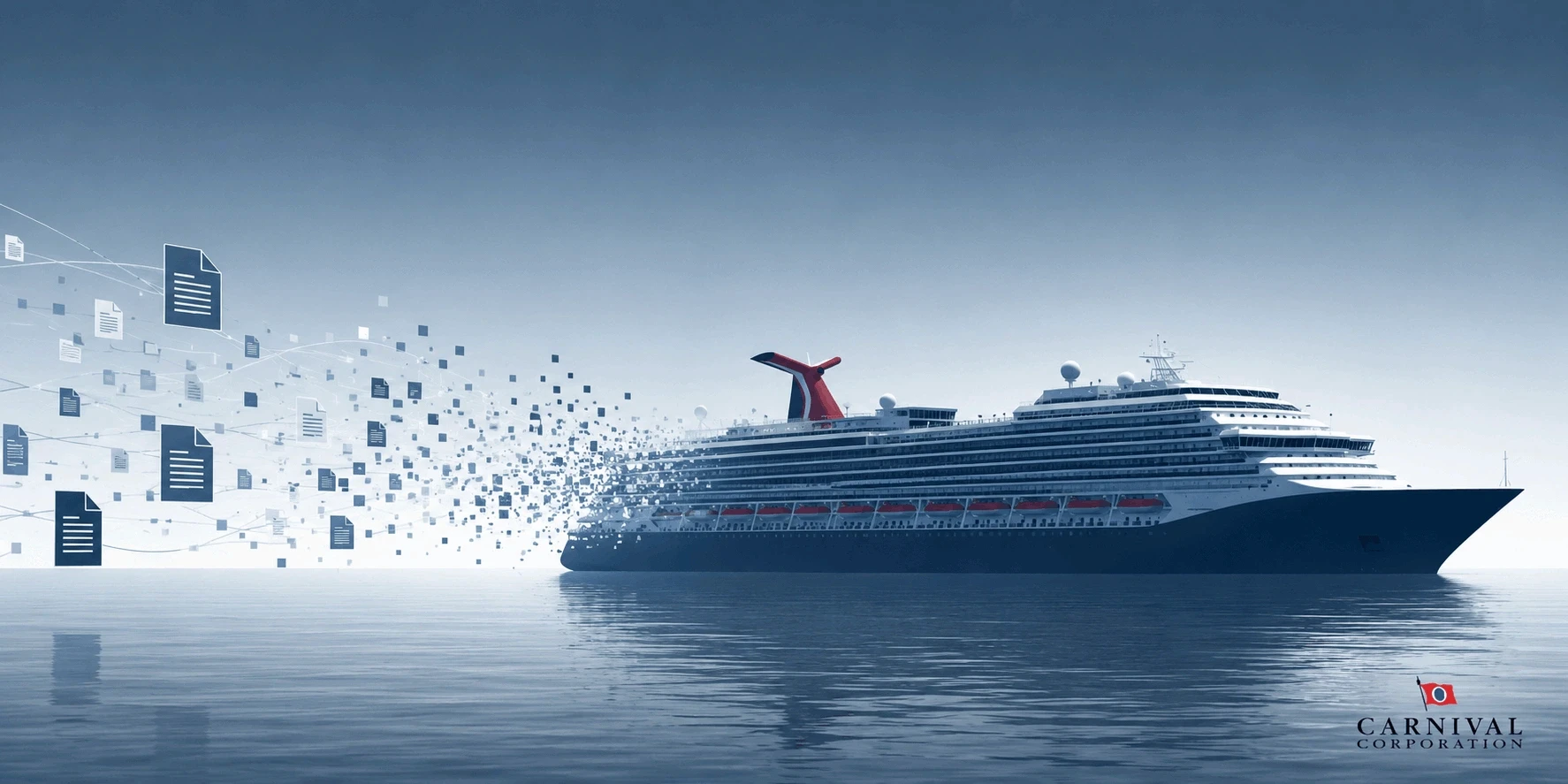
While Carnival reported that the unauthorized activity was identified and contained, the incident demonstrates a growing trend that cybersecurity professionals have been warning organizations about for years: attackers are increasingly targeting people instead of systems. Rather than exploiting a sophisticated software vulnerability, threat actors focused on manipulating an employee and leveraging legitimate credentials to gain access.
For business leaders, the lesson is clear. The greatest cybersecurity risk may no longer be an unpatched server or outdated firewall. It may be a trusted user account with too much access and insufficient protection.
Incident Facts
Category | Details |
|---|---|
Organization | Carnival Corporation |
Industry | Travel & Hospitality |
Discovery | Publicly disclosed May 2026 |
Attack Method | Social engineering and compromised employee account |
Individuals Affected | Approximately 5.99 million |
Data Exposed | Personal information including names, addresses, contact details, and identification information |
Operational Impact | Investigation and response activities initiated |
Response Actions | Threat containment, third-party forensic investigation, customer notifications, credit monitoring services |
Sources: Reuters, TechRadar
What Actually Happened?
According to public reporting, attackers used social engineering techniques to compromise an employee account. Once access was obtained, they leveraged legitimate credentials to access information within Carnival's environment.
This attack pattern is becoming increasingly common because modern organizations have significantly improved traditional perimeter security. Firewalls, endpoint detection, email filtering, and vulnerability management have all matured considerably over the last decade.
Attackers have adapted accordingly.
Instead of attempting to break through hardened technical defenses, they focus on stealing identities. Once they gain access to a legitimate user account, many security controls view their activity as authorized behavior.
This creates a dangerous challenge for security teams. The attacker often appears to be a normal employee performing routine work.
In many cases, detection occurs only after data has already been accessed or exfiltrated.
Why Identity Has Become the New Perimeter
Historically, organizations protected networks through a strong perimeter model. If users were inside the network, they were generally trusted.
Cloud adoption fundamentally changed that model.
Today, employees access applications from home offices, mobile devices, airports, hotels, and remote locations. Critical business applications reside in Microsoft 365, Salesforce, cloud storage platforms, ERP systems, legal practice management tools, and dozens of SaaS applications.
As a result, identity has effectively become the new security perimeter.
When attackers obtain valid credentials, they often gain direct access to business-critical systems without ever touching a corporate network.
The Carnival incident demonstrates this reality perfectly. The attack did not require a sophisticated software exploit. It required convincing a human being to provide access.
The Business Impact Beyond the Breach
Many executives evaluate cyber incidents solely based on operational disruption.
That approach misses the larger business risk.
The true costs of incidents like this often include:
Direct Costs
Incident response investigations
Legal counsel
Regulatory reporting
Customer notification requirements
Credit monitoring services
Security remediation efforts
Indirect Costs
Brand damage
Loss of customer confidence
Increased cyber insurance premiums
Executive distraction
Delayed strategic initiatives
Increased regulatory scrutiny
For publicly recognized brands, reputation damage can significantly exceed technical recovery costs.
Even organizations that restore systems quickly may spend years rebuilding customer trust.
Why This Matters for Private Equity Firms, Law Firms, and Manufacturers
The industries Kinetic Consulting Group serves face particularly elevated risks from identity-based attacks.
Private Equity
Private equity firms frequently maintain access to highly sensitive financial information, acquisition data, investor communications, and portfolio company systems.
A single compromised identity could potentially provide access to multiple organizations simultaneously.
Law Firms
Law firms maintain privileged information including litigation strategy, intellectual property, contracts, mergers and acquisitions data, and confidential client records.
Attackers understand the value of this information and increasingly target legal organizations through credential theft and business email compromise.
Manufacturing Organizations
Manufacturers often focus heavily on operational technology security while underestimating identity risks within ERP systems, supply chain platforms, and intellectual property repositories.
Compromised credentials can provide access to both business operations and production environments.
Risk Analysis
Risk Area | Business Impact | Likelihood |
Credential Theft | Unauthorized system access | High |
Social Engineering | User compromise | High |
Business Email Compromise | Financial fraud | High |
Data Exfiltration | Regulatory exposure | Medium to High |
Ransomware Deployment | Operational disruption | Medium to High |
Insider-Like Activity | Delayed detection | High |
Recent threat intelligence indicates ransomware groups generated approximately $529 million during the first quarter of 2026, representing a 39% increase compared to the same period in 2025. The growing specialization of criminal organizations continues to lower barriers for cybercriminals and increase overall attack volume.
How Organizations Should Respond
The Carnival breach highlights several practical steps organizations should prioritize immediately.
Strengthen Identity Security
Multi-factor authentication should be enforced across every critical platform.
Organizations should also implement conditional access policies that evaluate user risk, device trust, and location before granting access.
Reduce Excess Privileges
Users should only maintain the permissions necessary to perform their jobs.
Excessive permissions significantly increase attacker impact after credential compromise.
Improve Security Awareness Training
Modern awareness programs should focus heavily on social engineering tactics, phishing detection, impersonation attacks, and credential theft scenarios.
Implement Continuous Monitoring
Organizations should monitor for:
Impossible travel events
Unusual login behavior
Excessive data downloads
Suspicious mailbox activity
Privilege escalation attempts
Adopt a Zero Trust Approach
Every access request should be verified regardless of user location or device.
Trust should never be assumed solely because credentials are valid.
Kinetic Insight
One of the most dangerous assumptions organizations make is believing that cybersecurity incidents only happen because technology failed.
Increasingly, technology is working exactly as designed.
The problem is that attackers are using legitimate credentials.
The Carnival breach is another example of a trend we have observed across nearly every industry. Security investments continue to improve perimeter defenses while attackers increasingly focus on identities, permissions, and human behavior.
Organizations that continue to treat cybersecurity as purely a technology problem will struggle to keep pace with modern threats.
The future belongs to organizations that combine security awareness, identity protection, continuous monitoring, and Zero Trust architecture into a unified security strategy.
Key Takeaway
The most important lesson from the Carnival breach is not that a major organization suffered a cyberattack.
It is that a single compromised identity enabled attackers to access information associated with nearly six million individuals.
For business leaders, this should serve as a reminder that cybersecurity is no longer about protecting a network perimeter.
It is about protecting identities.
Organizations that strengthen identity security, reduce unnecessary privileges, monitor user behavior, and implement Zero Trust principles will be significantly better positioned to withstand the next generation of cyber threats.
Because in 2026, attackers are not always breaking in.
More often, they are simply logging in.