>
Managed IT
>
The IT Bottleneck Nobody Plans For: Why Growth Breaks Your Technology Before It Breaks Your Business
The IT Bottleneck Nobody Plans For: Why Growth Breaks Your Technology Before It Breaks Your Business
Growth is supposed to be the goal. More clients, more revenue, more opportunity. But for most small and mid-sized businesses, growth introduces a problem that rarely gets discussed until it becomes unavoidable, IT stops scaling.


At Kinetic Consulting Group, we see this pattern repeatedly. Businesses don’t fail because they grow too slowly, they struggle because their technology infrastructure cannot keep up with the pace of expansion. Systems that once felt stable begin to lag. Security gaps widen. Processes that worked for 10 employees collapse at 30. What looked like success on the surface quietly becomes operational risk underneath.
This is not a failure of effort or leadership. It is a failure of architecture.
And more importantly, it is predictable.
Growth Doesn’t Break Businesses, It Exposes Weak Systems
Most organizations build their IT environments reactively. A new employee joins, they get a license. A new office opens, a VPN gets configured. A new tool is needed, it gets added to the stack. Over time, this creates a patchwork environment that technically functions, but lacks cohesion.
That model works in early stages. It fails under scale.
The moment a business starts accelerating, the cracks begin to show. Identity management becomes inconsistent. Permissions drift. Data lives in multiple systems without governance. Security tools operate independently rather than as a unified defense layer.
This is the same underlying issue discussed in The Visibility Gap in Modern IT: Why Most Security Stacks Fail When It Matters Most, where the illusion of coverage hides the reality of fragmentation. Growth amplifies that fragmentation.
The result is not immediate failure. It is slow degradation.
The Hidden Cost of Scaling Without Structure
When IT doesn’t scale properly, the impact is not always obvious at first. It rarely presents as a single catastrophic event. Instead, it shows up as friction across the business.
Teams start waiting on systems. File access becomes inconsistent. Applications slow down. Onboarding new employees takes longer than it should. Support tickets increase, but none of them seem critical individually.
This is where many businesses misjudge the situation. They assume these are minor inefficiencies. In reality, they are early indicators of systemic strain.
Over time, that strain compounds into measurable cost.
Operational Impact of IT Bottlenecks
Area | Early Stage Symptom | Growth Stage Impact |
|---|---|---|
User Access | Occasional permission issues | Delayed onboarding, security exposure |
File Systems | Slow sync or access delays | Data inconsistency, productivity loss |
Security Tools | Alert noise, low visibility | Missed threats, increased breach risk |
IT Support | Ticket backlog | Business disruption, employee frustration |
Application Stack | Redundant tools | Increased cost, reduced efficiency |
This aligns closely with what we outlined in More Tools, More Risk: The Operational Failure Behind Modern IT Stacks, where tool sprawl becomes a direct driver of operational risk.
The more a business grows without consolidating its IT strategy, the more complexity becomes the enemy.
Why Traditional IT Models Fail During Growth
Most IT environments are built on one of two flawed models.
The first is the “break-fix” mindset, where IT exists primarily to respond to issues. The second is the “fully managed” illusion, where businesses believe outsourcing alone solves structural problems.
Neither model is designed for scalability.
Reactive IT cannot anticipate growth-related strain. It only responds after impact has already occurred. On the other side, many managed service providers focus on maintenance, not architecture. They keep systems running but rarely redesign them for scale.
This is the same issue highlighted in The Hidden Risk in “Fully Managed” IT: Why Most MSPs Fail at True Accountability, where accountability ends at uptime rather than extending to performance, security, and scalability.
Growth requires a fundamentally different approach.
The Breaking Point: When IT Becomes the Bottleneck
Every business hits a threshold where IT shifts from being a support function to a limiting factor. This is the inflection point.
At this stage, leadership begins asking different questions.
Why does onboarding take days instead of hours
Why are security audits becoming more difficult
Why are we adding tools but not gaining efficiency
Why does every change feel risky
These are not isolated problems. They are symptoms of an environment that was never designed to scale.
The danger is that many businesses try to solve these issues incrementally. They add another tool, hire another technician, or increase support capacity. While those actions may provide short-term relief, they do not address the underlying architecture.
Eventually, the cost of inefficiency exceeds the cost of transformation.
Security Degradation During Growth
One of the most overlooked consequences of IT bottlenecks is the impact on security posture.
As businesses grow, their attack surface expands. More users, more devices, more applications, more access points. Without a structured approach to identity and access management, this creates significant risk.
Permissions that were manually assigned early on become difficult to track. Legacy accounts remain active. Conditional access policies are either too broad or inconsistently applied.
This is where many organizations believe they are secure because they have the right tools in place. Antivirus, EDR, MFA, backup solutions. But tools alone do not create security.
Execution does.
As discussed in Antivirus vs. EDR: Which Is Better for Your Business, the effectiveness of security depends on how systems are integrated and managed, not just which tools are deployed.
Growth without governance leads to security gaps that are often invisible until exploited.
The Role of Identity in Scalable IT
If there is a single component that defines whether an IT environment can scale effectively, it is identity.
Modern IT is no longer built around networks. It is built around users, devices, and access.
When identity is centralized and properly managed, scaling becomes significantly easier. Users can be onboarded quickly, permissions can be assigned consistently, and security policies can be enforced across the organization.
When identity is fragmented, everything becomes harder.
This is particularly relevant for businesses that have grown through acquisition or expansion, where multiple environments must be integrated. Without a unified identity strategy, these environments remain siloed, creating inefficiency and risk.
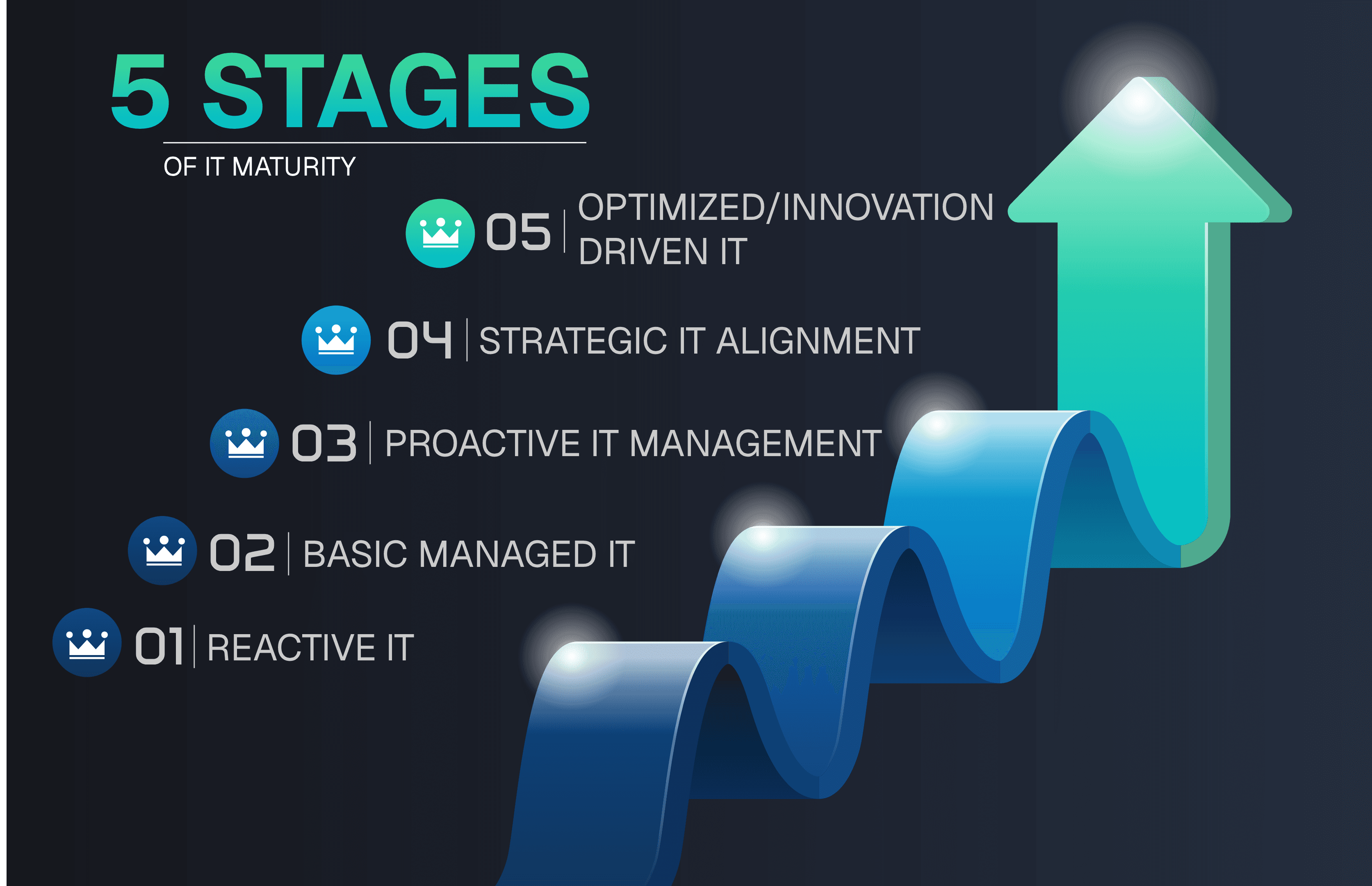
This concept ties directly into the architectural challenges explored in The IT Maturity Model: How Growing Businesses Scale Technology Without Breaking Operations, where identity maturity is a key indicator of overall IT scalability.
The Financial Reality of IT Bottlenecks
One of the biggest misconceptions about IT investment is that it is a cost center rather than a growth enabler.
In reality, poorly structured IT environments are one of the most expensive problems a business can have.
The cost is not just in downtime or security incidents. It is in lost productivity, delayed initiatives, and missed opportunities.
Cost Drivers of Poor IT Scalability
Cost Category | Description | Business Impact |
|---|---|---|
Productivity Loss | Employees waiting on systems or access | Reduced output per employee |
IT Labor Overhead | Increased time spent managing complexity | Higher operational costs |
Security Risk | Increased likelihood of breaches | Financial and reputational damage |
Tool Redundancy | Paying for overlapping solutions | Wasted budget |
Downtime | System instability during growth | Revenue loss |
These costs often go unnoticed because they are distributed across the organization. But when combined, they represent a significant drag on growth.
This is why businesses that invest in structured IT early tend to outperform those that delay. They remove friction before it becomes systemic.
What Scalable IT Actually Looks Like
Scalable IT is not about having more tools or more staff. It is about having the right architecture.
At its core, a scalable IT environment has three defining characteristics.
First, it is standardized. Systems are built using consistent frameworks rather than ad hoc configurations.
Second, it is centralized. Identity, security, and management are unified rather than fragmented.
Third, it is automated. Processes that would otherwise require manual intervention are handled programmatically.
When these elements are in place, growth becomes significantly easier to manage.
New users can be onboarded in minutes. Security policies apply automatically. Systems remain consistent regardless of scale.
This is the difference between IT that supports growth and IT that limits it.
The Shift from Reactive to Strategic IT
The transition from a reactive IT model to a strategic one is not just a technical change. It is a mindset shift.
Instead of asking how to fix problems, businesses begin asking how to prevent them. Instead of focusing on uptime, they focus on performance and scalability. Instead of measuring IT by cost, they measure it by impact.
This is where Kinetic’s philosophy of Strategy. Security. Scalability. becomes critical.
Strategy ensures that IT aligns with business goals. Security ensures that growth does not introduce unacceptable risk. Scalability ensures that systems can evolve alongside the organization.
Without all three, growth will eventually create friction.
When to Make the Transition
One of the most common questions we get is when a business should start thinking about scalable IT.
The answer is earlier than most expect.
If your organization is experiencing any of the following, it is already time.
Onboarding new employees takes longer than a few hours
Access permissions are managed manually or inconsistently
Multiple tools perform similar functions
Security policies are not standardized across users
IT support tickets are increasing with growth
These are not isolated issues. They are indicators that your current model will not scale.
Waiting until these problems become critical only increases the cost and complexity of fixing them.
Kinetic Insight: Growth Should Be an Advantage, Not a Risk
The businesses that scale successfully are not the ones with the most resources. They are the ones with the best structure.
Growth is an opportunity to build something more efficient, more secure, and more resilient. But that only happens when IT is designed with intention.
At Kinetic Consulting Group, we approach IT as a growth platform, not a support function. That means building environments that are designed to scale from day one, not retrofitted after problems emerge.
Because in today’s landscape, the difference between companies that scale smoothly and those that struggle is not ambition.
It is architecture.
Final Takeaway
If your IT environment feels like it is getting harder to manage as your business grows, that is not normal. It is a signal.
Technology should simplify operations as you scale, not complicate them.
The longer these issues are ignored, the more they compound. And by the time they become obvious, they are already expensive.
The good news is that this is solvable. With the right strategy, the right structure, and the right execution, IT can become a competitive advantage rather than a bottleneck.